Research
A full publication list can be found here, and a condensed list here
A PDF link of my CV
CHAMPSS
The 'CHIME All-Sky Multiday Stack Search' is a daily, full-sky search for pulsars, piggybacking the CHIME/FRB datastream. Most pulsar searches to date used traditional radio dishes, tiling the sky once, or focussing on regions were pulsars are expected to live a priori. Due to the half-pipe nature of CHIME, we will see the whole northern sky daily, allowing us to detect transient pulsars, as well as fainter pulsars through stacking.
After leading massive hardware upgrades at the CHIME-site to the storage and compute infrastructure, the scaled up search has begun at the beginning of 2026! A pilot survey discovered the first 11 pulsars (and counting), with many more to come! Read about our first discoveries, and system overview 1
Page with our up-to-date pulsar discoveries
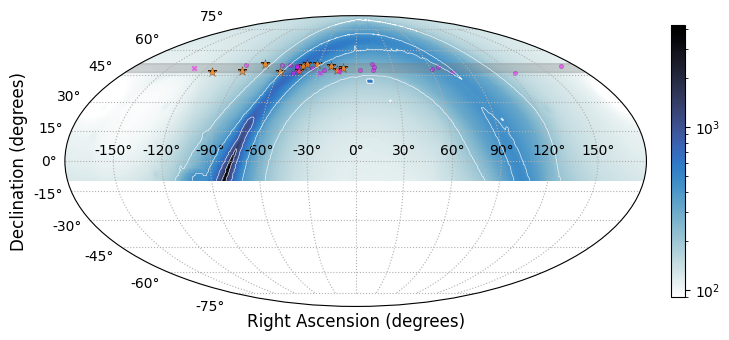 Pointing map for CHAMPSS, the colourbar represents the total electron column of the Milky Way, and thus how 'deep' our search must observe. The horizontal strip shows our pilot survey, with all pulsars discovered (new discoveries in orange).
Scintillometry
Scintillation Arcs are a powerful tool to probe the ionized interstellar medium on tiny scales. They reveal scattering dominated from thin, sometimes highly anisotropic regions. The arc curvature contains the relative motion of the pulsar, earth, and the screen. Annual variations, or VLBI can be used to map and locate these screens in the IISM. Knowing the screen geometry, the scintillation pattern serves as a ~10AU interferometer with which one can study the pulsar, used to study pulsar orbits and to probe pulsar magnetospheres.
Recent Papers:
- More than 20 scintillation arcs towards J0437-4715! 2
- Scintillation arcs towards >100 pulsars (and see artistic rendition below) 3
- Scintillometry of FRBs! 4
- Surprises from long-term monitoring of B1508+55, and a 2-screen model 5
- Scintillation arcs towards PTA pulsars, and implications for precision timing 6
- Scattering screen pinned down to a foreground HII region 7
- Probing the surprising emission of the Crab Pulsar's Giant Pulses 8
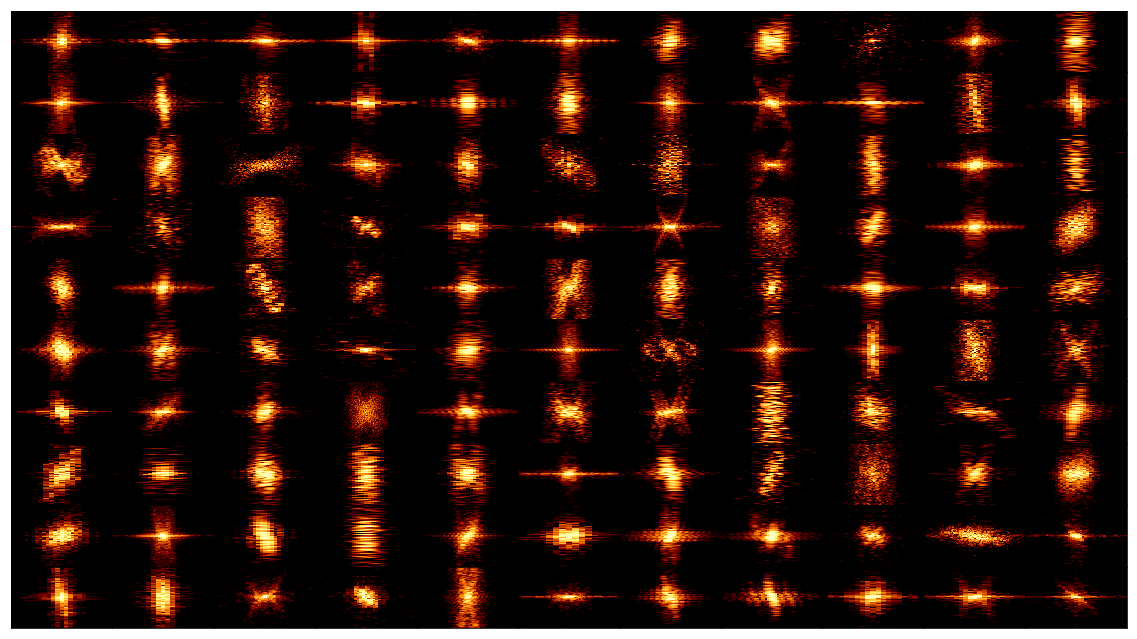 Panorama of scintillation arcs seen with the MeerKAT Thousand Pulsar Array3 Each panel is a 'delay' vs 'Doppler' map of scattered images towards a pulsar, which can be used to map the scattering screen on <mas scales.
Plasma Lensing in Eclipsing Binaries
A class of pulsars called 'spiders', the pulsar is irradiating a low-mass companion, driving an ionized wind. Often, pulsed emission is fully eclipsed for a large part of its orbit, absorbed or obscured by the wind. In the edges of the eclipse, the pulsed emission can still be seen, but is delayed and scattered. This variable ionized wind acts as a lens, which can amplify pulse signals by orders of magnitude, and even resolve pulse components. These systems also serve as laboratories for extreme propagation effects, as we have a clean reference when the pulse is far from eclipse
Recent Papers:
- Discovery of extreme lensing in B1957+20 9
- Wind velocity from modelling the broad-scale lensing variations in J2051-0827 10 and B1957+20 11
- Extreme magnetism in eclipsing wind of B1744-24A 12
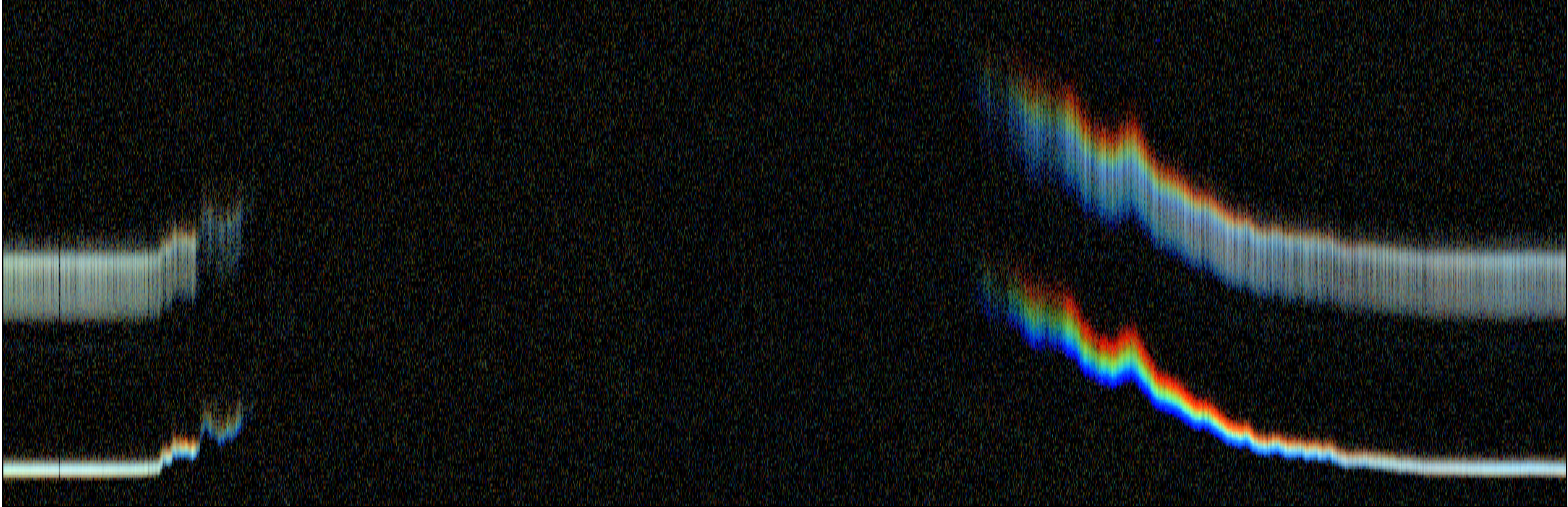 Radio emission surrounding the eclipse of the `black widow' pulsar B1957+20, where colour is mapped to the radio frequency. Surrounding the eclipse, the effects of dispersion and scattering can be seen through the chromatic delays, while the light flickers due to the lensing from the same material.
-
Christopher Andrade, Charanjot Brar, Alyssa Cassity, Kathryn Crowter, Davor Cubranic, Abigail K. Denney, Fengqiu Adam Dong, Emmanuel Fonseca, Ajay Kumar, Lars Künkel, Magnus L'Argent, Dustin Lang, Robert A. Main, Kiyoshi W. Masui, Sujay Mate, Juan Mena-Parra, Bradley W. Meyers, Cherry Ng, Aaron B. Pearlman, Ue-Li Pen, Scott M. Ransom, Alexander P. Roman, Kendrick Smith, Reynier Squillace, Ingrid Stairs, Chia Min Tan, Laurent Tarabout, Xia Wenke, and Tarik J. Zegmott. Chime all-sky multiday pulsar stacking search (champss): system overview and first discoveries. 2025. URL: https://arxiv.org/abs/2504.16293, arXiv:2504.16293. ↩
-
Daniel J. Reardon, Robert Main, Stella Koch Ocker, Ryan M. Shannon, Matthew Bailes, Fernando Camilo, Marisa Geyer, Andrew Jameson, Michael Kramer, Aditya Parthasarathy, Renée Spiewak, Willem van Straten, and Vivek Venkatraman Krishnan. Bow shock and local bubble plasma unveiled by the scintillating millisecond pulsar j0437−4715. Nature Astronomy, ():, 2025. URL: https://doi.org/10.1038/s41550-025-02534-6, doi:10.1038/s41550-025-02534-6. ↩
-
R. A. Main, A. Parthasarathy, S. Johnston, A. Karastergiou, A. Basu, A. D. Cameron, M. J. Keith, L. S. Oswald, B. Posselt, D. J. Reardon, X. Song, and P. Weltevrede. The Thousand Pulsar Array programme on MeerKAT - X. Scintillation arcs of 107 pulsars. \mnras , 518(1):1086–1097, January 2023. arXiv:2211.08471, doi:10.1093/mnras/stac3149. ↩↩
-
R. A. Main, S. Bethapudi, V. R. Marthi, M. L. Bause, D. Z. Li, H. -H. Lin, L. G. Spitler, and R. S. Wharton. Modelling annual scintillation velocity variations of FRB 20201124A. \mnras , 522(1):L36–L41, June 2023. arXiv:2212.04839, doi:10.1093/mnrasl/slad036. ↩
-
Tim Sprenger, Robert Main, Olaf Wucknitz, Geetam Mall, and Jason Wu. Double-lens scintillometry: the variable scintillation of pulsar B1508 + 55. \mnras , 515(4):6198–6216, October 2022. arXiv:2204.13985, doi:10.1093/mnras/stac2160. ↩
-
R. A. Main, J. Antoniadis, S. Chen, I. Cognard, H. Hu, J. Jang, R. Karuppusamy, M. Kramer, K. Liu, Y. Liu, G. Mall, J. W. McKee, M. B. Mickaliger, D. Perrodin, S. A. Sanidas, B. W. Stappers, T. Sprenger, O. Wucknitz, C. G. Bassa, M. Burgay, R. Concu, M. Gaikwad, G. H. Janssen, K. J. Lee, A. Melis, M. Pilia, A. Possenti, L. Wang, and W. W. Zhu. Variable scintillation arcs of millisecond pulsars observed with the Large European Array for Pulsars. \mnras , 525(1):1079–1096, October 2023. arXiv:2306.13462, doi:10.1093/mnras/stad1980. ↩
-
G. Mall, R. A. Main, J. Antoniadis, C. G. Bassa, M. Burgay, S. Chen, I. Cognard, R. Concu, A. Corongiu, M. Gaikwad, H. Hu, G. H. Janssen, R. Karuppusamy, M. Kramer, K. J. Lee, K. Liu, J. W. McKee, A. Melis, M. B. Mickaliger, D. Perrodin, M. Pilia, A. Possenti, D. J. Reardon, S. A. Sanidas, T. Sprenger, B. W. Stappers, L. Wang, O. Wucknitz, and W. W. Zhu. Modelling annual scintillation arc variations in PSR J1643-1224 using the Large European Array for Pulsars. \mnras , 511(1):1104–1114, March 2022. arXiv:2201.04245, doi:10.1093/mnras/stac096. ↩
-
Robert Main, Rebecca Lin, Marten H. van Kerkwijk, Ue-Li Pen, Alexei G. Rudnitskii, Mikhail V. Popov, Vladimir A. Soglasnov, and Maxim Lyutikov. Resolving the Emission Regions of the Crab Pulsar's Giant Pulses. \apj , 915(1):65, July 2021. doi:10.3847/1538-4357/ac01c6. ↩
-
Robert Main, I. -Sheng Yang, Victor Chan, Dongzi Li, Fang Xi Lin, Nikhil Mahajan, Ue-Li Pen, Keith Vanderlinde, and Marten H. van Kerkwijk. Pulsar emission amplified and resolved by plasma lensing in an eclipsing binary. \nat , 557(7706):522–525, May 2018. arXiv:1805.09348, doi:10.1038/s41586-018-0133-z. ↩
-
F. X. Lin, R. A. Main, J. P. W. Verbiest, M. Kramer, and G. Shaifullah. Discovery and modelling of broad-scale plasma lensing in black-widow pulsar J2051 - 0827. \mnras , 506(2):2824–2835, September 2021. arXiv:2106.12359, doi:10.1093/mnras/stab1811. ↩
-
F. X. Lin, R. A. Main, D. Jow, D. Z. Li, U. -L. Pen, and M. H. van Kerkwijk. Plasma lensing near the eclipses of the Black Widow pulsar B1957+20. \mnras , 519(1):121–135, February 2023. arXiv:2208.13868, doi:10.1093/mnras/stac3456. ↩
-
Dongzi Li, Anna Bilous, Scott Ransom, Robert Main, and Yuan-Pei Yang. A highly magnetized environment in a pulsar binary system. \nat , 618(7965):484–488, June 2023. arXiv:2205.07917, doi:10.1038/s41586-023-05983-z. ↩